Deep learning prediction of ionic conductivity in polymer electrolytes
using hierarchical polymer graphs
(Chemical Engineering Journal 2025 IF: 13.3)
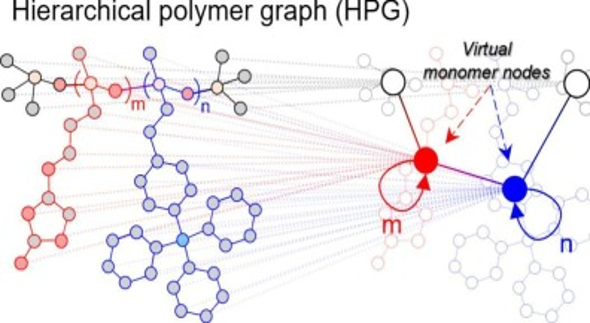
Polymer electrolytes have emerged as essential materials with critical importance in a wide range of electrochemical technologies, including batteries, fuel cells, and supercapacitors. However, accurately predicting the ionic conductivity of polymer electrolytes remains a significant challenge due to the complex and multiscale nature of polymer structures. Conventional machine learning methods relying on simplified representations of polymers like SMILES-based descriptors often fail to capture the detailed chemical and topological information of polymer structures. In this study, we introduce a novel hierarchical polymer graph (HPG) representation that describes polymer structures at multiscale levels of complexity, encompassing monomer-level chemical features and polymer chain-level structural features. By integrating HPG with graph neural networks, particularly graph attention network (GAT), we demonstrate improved accuracy and generalization in predicting the ionic conductivity of polymer electrolytes with diverse polymer structures including homopolymers, block copolymers, alternating copolymers, and branched polymers. In addition, our best DL model, HPG-GAT, reasonably predicts temperature-dependent ionic conductivity of polymer electrolytes, capturing both linear Arrhenius-type and nonlinear VTF-type behaviors. The HPG is shown to be a generalizable and scalable framework that bridges the gap between polymer informatics and property prediction. HPG-based DL models have great potential to accelerate the design and development of high-performance polymer electrolytes for next-generation energy storage applications, including polymer electrolyte-based batteries and supercapacitors.
DOI 링크 : https://www.sciencedirect.com/science/article/pii/S1385894725076673