Dual Multi-Resonance green emitter with steric shielding and core distortion for Solution-Processed TADF-OLEDs
(Chemical Engineering Journal, 2025,506 IF:13.3)
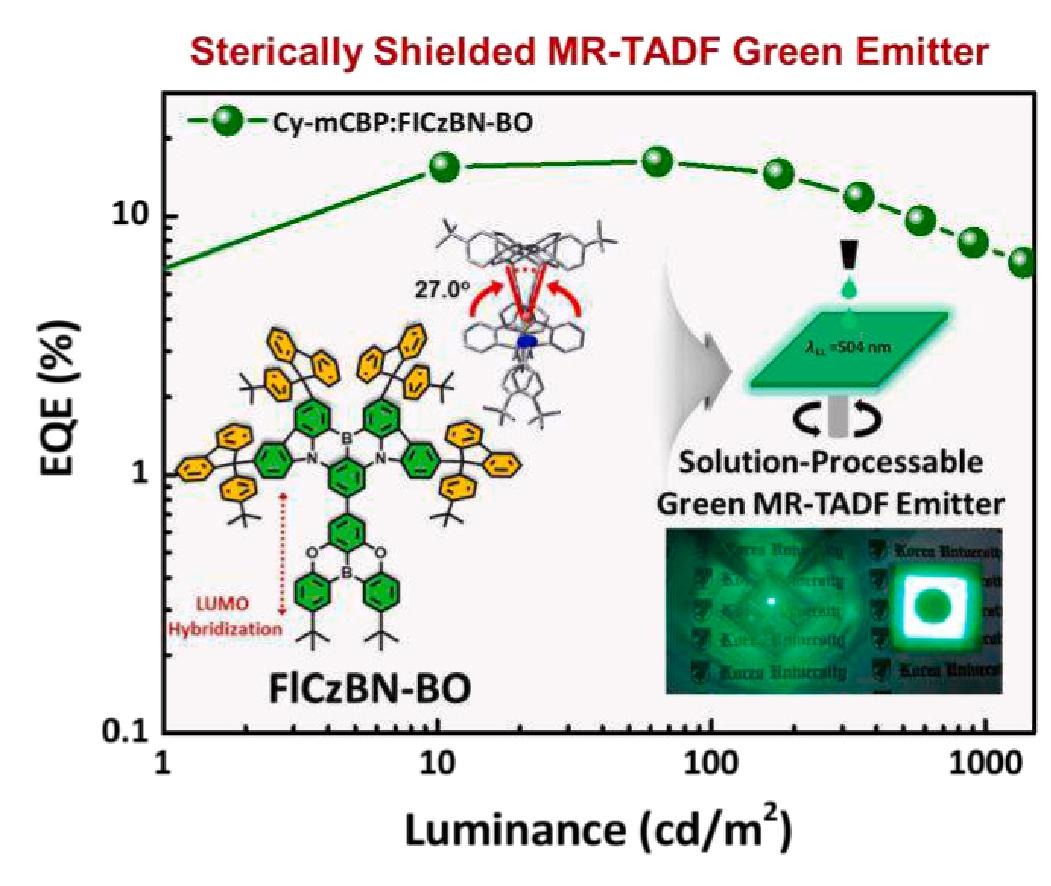
Based on a multi-resonance (MR) − thermally activated delayed fluorescence (TADF) emitter structure, we aim to convert a blue emissive emitter to green by adding an oxygen-bridged boron moiety, synthesizing FlCzBN-BO using two MR components, tDOBNA and FlCzBN. To utilize it in solution-processed organic light-emitting diodes (OLEDs), we enhance its solubility by introducing tert-butylphenyl-fluorene substituent. The hybridization of the lowest unoccupied molecular orbital of the tDOBNA and BCzBN units plays a crucial role in reducing the HOMO-LUMO energy gap of FlCzBN-BO while ensuring a narrow emission bandwidth. Notably, FlCzBN-BO exhibits a smaller singlet–triplet energy splitting (ΔEST), higher reverse intersystem crossing (RISC) rate and lower activation energy for the RISC compared to BCzBN-BO. This smaller ΔEST is attributed to the structural distortion of the CzBN emitting core, induced by the presence of bulky peripheral groups. Ultimately, solution-processed OLEDs utilizing FlCzBN-BO achieve an external quantum efficiency of 16.26 %, emitting green light at 504 nm with a full width at half-maximum of 31 nm. Particularly, the performance of the device with FlCzBN-BO shows reduced sensitivity to doping concentration due to the steric shielding effect of the phenyl-fluorene substituents. The design strategy for a green emitter using dual MR frameworks and steric shielding is crucial for advancing solution-processed MR-TADF emitters, enhancing their potential for future applications in delayed fluorescence.